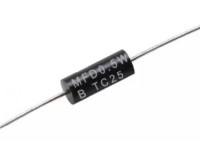
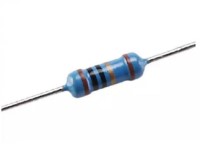
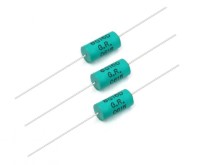
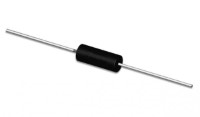
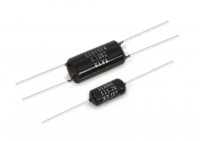
The MFD series is a range of high precision metal film leaded resistors offering tolerance grades down to ±0.02% and temperature coefficients of resistance (TCR) as low as ±5 ppm/°C, placing the series among the tightest-specified leaded resistors available for general-purpose through-hole circuit assembly. The resistive element is a nickel alloy film deposited on an alumina ceramic cylindrical core — a construction that combines the dimensional stability and electrical insulating properties of the ceramic substrate with the predictable, low-noise characteristics of nickel alloy film technology. Two package sizes are offered: the MFD0727 with a 7.0mm body diameter rated at 1/4W, and the MFD1040 with a 10.2mm body diameter rated at 1/2W, both sharing tinned iron end-cap terminals, tinned annealed copper lead wires, and a protective epoxy overcoat with exposed-base ink resistance marking.
The resistance range spans 10Ω to 500kΩ for the tightest ±0.02% tolerance grade, extending to 10Ω to 1MΩ for the ±0.05% and ±0.1% grades. Four TCR grades are available — ±5, ±10, ±15, and ±25 ppm/°C — with the lowest TCR grades being typically paired with the tightest tolerance grades to deliver resistors whose values remain stable both at initial measurement and as temperature varies across the −55°C to +155°C operating range. Maximum operating voltages of 250V and 300V for the 0727 and 1040 respectively, with overload voltages of 500V and 600V, confirm the series is suited to industrial and instrumentation line-voltage environments. Insulation resistance exceeds 1,000MΩ when tested at 500V DC for one minute.
Qualification testing is conducted to MIL-STD-202 and JIS-C 5201-1, with the test programme covering short-time overload at 2.5 times rated power for 5 seconds, 1,000-hour endurance at rated working voltage and 70°C, 1,000-hour damp heat with load at 40°C and 90–95% relative humidity, resistance to soldering heat at 350°C, pulse overload at four times the rated continuous working voltage for 10,000 cycles, five-cycle temperature cycling from −55°C to +85°C, terminal tensile strength of at least 2.5kg, and resistance to solvent immersion. The derating curve requires power reduction beginning at 70°C and reaching zero dissipation at 155°C, consistent with the thermal limits of the epoxy overcoat and the nickel alloy resistive element.
Within the RARA precision resistor family, the MFD occupies the highest precision tier of the leaded metal film types, sitting above the MFR leaded series in terms of tolerance and TCR performance, and offering the through-hole form factor that is often preferred in precision instrumentation, calibration, and laboratory equipment where socketed or hand-soldered assembly is standard. Its combination of ±0.02% tolerance and ±5 ppm/°C TCR represents a level of accuracy more commonly associated with precision wirewound types, delivered in the lower-cost and more readily assembled metal film construction.