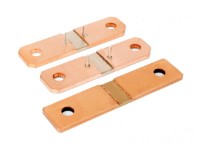
PCBS Series Automotive PCB-Integrated Shunt Current Sensing Modules


Automotive-grade integrated current sensing modules combining a low-TCR shunt resistor, NTC temperature sensor, and PCBA in a single bolt-mounted assembly for bidirectional DC current measurement
Four models: PCBS6918B100P2AC00 (100 μΩ, ±350 A), PCBS8436P025T2AC00 (25 μΩ, ±1000 A), PCBS8518A050P1SC00 (50 μΩ, ±350 A), and PCBS8536P050T1SN00 (50 μΩ, ±600 A)
Shunt resistance range 25 μΩ to 100 μΩ; tolerance ±5%; TCR ≤±100 ppm/°C
Integrated NTC thermistor 10 kΩ ±1% for simultaneous shunt temperature measurement
Per-unit data matrix encoding the factory-measured initial resistance R₀ ±0.2% and quadratic temperature compensation coefficients A, B, and C
Molex connector: 4-pin (S+, S−, T1, T2) for single-channel models; 9-pin (multi-channel sense, GND, T1, T2) for dual-channel models
Copper bar connection via M6 or M8 bolts with recommended torque of 8–10 Nm or 15–20 Nm respectively
Operating temperature range −40°C to +125°C; shunt element rated −55°C to +175°C
Qualified to VW 80000-2021 and GB/T automotive test standards; RoHS and REACH compliant
Customisable to specific technical requirements


What are the PCBS Series Automotive PCB-Integrated Shunt Current Sensing Modules?


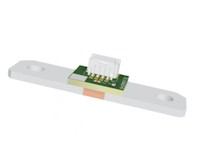
The PCBS series is a family of integrated automotive current sensing modules that combine a precision low-resistance shunt, an NTC temperature sensor, and a signal conditioning PCBA in a single bolt-mounted assembly designed for direct integration into battery disconnect units (BDU) and power distribution units (PDU) in electric and hybrid vehicle powertrains. Unlike bare shunt resistors that require external signal conditioning circuitry and temperature compensation to be designed into the host system, each PCBS module delivers a conditioned, temperature-compensated current signal directly to the user’s signal processing module through a standardised Molex connector, substantially reducing the design and calibration burden on the system integrator. The module is described as a PCB+SHUNT assembly and is customisable to specific technical requirements.

The shunt element in each PCBS module operates at the micro-ohm level — 25 μΩ, 50 μΩ, or 100 μΩ — to accommodate bidirectional continuous currents from ±350 A to ±1000 A within the rated operating range, and peak currents significantly beyond this on a short-term basis: up to ±1000 A for 5 seconds on the 100 μΩ model and up to ±3000 A for 5 seconds on the 25 μΩ model. The shunt TCR is ≤±100 ppm/°C, and the integrated NTC thermistor — rated at 10 kΩ ±1% with a B-value of 3434 K or 3435 K depending on model — allows the host system to read shunt temperature continuously and apply real-time temperature compensation to the measured resistance using the quadratic correction formula Rₜ = R₀ × Rᶜᵒᵐᵖ(T), where Rᶜᵒᵐᵖ is computed from the per-unit polynomial coefficients A, B, and C encoded in the data matrix label on each module.

Each PCBS unit is individually characterised at the factory, and the measured initial resistance R₀ at 25°C ±2°C, accurate to ±0.2%, together with the three temperature compensation coefficients, is encoded in a data matrix label applied to the PCB cover. This per-unit calibration data allows the host BMS or signal processor to correct for both the absolute resistance value at reference temperature and its temperature-dependent drift, achieving current measurement accuracy substantially better than the ±5% shunt tolerance alone would suggest. The connector pinout is defined for two configurations: a 4-pin Molex 5023520400 connector carrying the current signal positive and negative sense lines and two NTC temperature sensor pins for the single-channel models, and a 9-pin Molex 5023520900 connector with multiple current signal group pairs, a common-mode ground, and NTC pins for the dual-channel models. Installation requires copper bar connections of the recommended width and thickness, overlapping the shunt by at least 20 mm and clamped without flat washers between the bar and shunt surface to preserve the integrity of the electrical contact. Qualification testing is performed to VW 80000-2021 and relevant GB/T Chinese national standards, covering insulation resistance, dielectric strength, temperature drift, high and low temperature ageing, thermal shock, damp heat, temperature cycle durability, salt spray, free fall, vibration, and mechanical shock.

PCBS PDF Download
PCBS STEP Download


PCBS Series Automotive PCB-Integrated Shunt Current Sensing Modules Specifications


A practical overview for engineers and procurement teams evaluating resistive solutions.


PCBS AEC-Q200 PCB+shunt
Model: PCBS
Resistor type: AEC-Q200 PCB+shunt
Description: Current sensing module
Rated Current: 350~1000A
Resistance (Ω): 25u, 50u, 100u
Tolerance (%): ±5
TCR (ppm/C): 100


Applications of the PCBS Series Automotive PCB-Integrated Shunt Current Sensing Modules


Where RARA metal clad resistors are deployed in the field.


Battery management system main current measurement — bidirectional sensing of the total charge and discharge current of high-voltage EV and HEV battery packs within the BMS, where the integrated NTC temperature sensor and per-unit polynomial calibration data allow the host controller to apply real-time temperature-compensated resistance correction and achieve current measurement accuracy sufficient for state-of-charge and state-of-energy estimation over the full service life of the battery
Battery disconnect unit current sensing — inline current measurement within the BDU of electric vehicles, where the bolt-on copper bar connection of the PCBS module allows it to be integrated directly into the main high-voltage bus without additional current sense hardware, and the standardised Molex connector simplifies wiring harness integration and service replacement
Power distribution unit current monitoring — measurement of current flowing through the PDU in EV and HEV powertrains, where the high peak current tolerance of the PCBS series (up to ±3000 A for 5 seconds) accommodates the transient overload conditions associated with motor starting, regenerative braking events, and short-circuit protection responses
On-board charger input and output current measurement — bidirectional current sensing at the AC-DC and DC-DC stages of automotive on-board chargers, where the temperature compensation capability of the PCBS module maintains calibrated current measurement accuracy across the wide thermal range experienced during both cold-start charging and thermally loaded fast-charging sessions
Fuel cell vehicle power flow monitoring — measurement of current exchange between fuel cell stack, high-voltage battery buffer, and traction inverter in fuel cell electric vehicles, where the high continuous current rating and accurate bidirectional sensing of the PCBS series support the energy management decisions of the fuel cell system controller
Heavy commercial vehicle and bus powertrain current sensing — main current measurement in the high-voltage systems of electric buses, trucks, and commercial vehicles, where the ±1000 A continuous rating and ±3000 A pulse capability of the 25 μΩ model cover the larger battery and motor currents of commercial vehicle drivetrains and the bolt-on bus-bar mounting suits the heavy-duty wiring practices of this sector
Stationary energy storage system current measurement — sensing of charge and discharge current in grid-connected battery energy storage systems sharing the same high-current bus-bar architecture as automotive applications, where the per-unit factory calibration and temperature compensation of the PCBS module reduce the system-level calibration effort and support accurate bidirectional energy metering
Industrial DC bus and fast-charging infrastructure current sensing — current measurement in high-power DC fast-charging stations and industrial DC distribution systems, where the PCBS module’s integrated temperature sensing, factory calibration, and high peak current tolerance provide a complete, connector-ready sensing solution for systems that must accurately measure large and rapidly varying bidirectional currents in thermally challenging environments


Related Products of the PCBS Series Automotive PCB-Integrated Shunt Current Sensing Modules


TCS8536  AEC-Q200 Resistor


Model: TCS8536
Resistor type: AEC-Q200 E-beam
Description: E-beam welded shunt
Power Rating: 36W
Rated Current: 600~1200A
Resistance (Ω): 0.1m, 0.05m, 0.025m
Tolerance (%): ±1, ±2, ±5
TCR (ppm/C): 100

TCS8440T  AEC-Q200 Resistor


Model: TCS8440T
Resistor type: AEC-Q200 E-beam
Description: E-beam welded shunt
Power Rating: 36W
Rated Current: 840A
Resistance (Ω): 0.05m
Tolerance (%): ±1, ±2, ±5
TCR (ppm/C): 100

ECS  AEC-Q200 Resistor


Model: ECS
Resistor type: AEC-Q200
Description: Chip shunt
Power Rating: 1W~15W
Resistance (Ω): 0.2~10m
Tolerance (%): ±1, ±2, ±5
TCR (ppm/C): 100-200

TCS  AEC-Q200 Resistor


Model: TCS
Resistor type: AEC-Q200 E-beam
Description: Shunt
Power Rating: 12W~36W
Rated Current: 200~350A
Resistance (Ω): 0.05~0.5m
Tolerance (%): ±1, ±2, ±5
TCR (ppm/C): 100


Why Choose RARA Current Sensing Resistors


What sets RARA apart for engineers and procurement managers in industrial and automotive markets.


01
8 Sub-Categories

No other single supplier covers AEC-Q200 chip shunts, milliohm precision types, four-terminal Kelvin shunts, power metering, and 12,000A panel shunts under one ISO-certified roof.

02
Extreme Precision

HPS, UHPS, and PSS precision shunts deliver ±0.05% tolerance and 3 ppm/°C TCR — meeting the accuracy demands of EV battery coulomb counting, precision power analyzers, and billing-grade energy metering.
03
Automotive Qualified

Multiple AEC-Q200 certified models (BCS, LRA, ECS, BWR, TCS, PCBS) with IATF 16949 manufacturing certification — covering EV battery management, motor control, and charging applications.
04
Global Track Record

Trusted by Tesla, GM Korea, Proterra, Siemens, Rockwell, and Schneider Electric — deployed in EV powertrains, industrial drives, and utility metering systems across six continents.


This is the RARA X Accountthis is the RARA Facebook Accountthis is the RARA Instagram Accountthis is the RARA Youtube Video
Products & Downloads
Information & Schedule

© 2026 RARA Electronics LLC