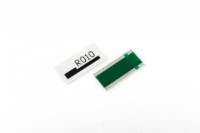
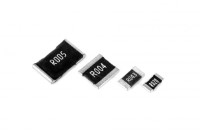
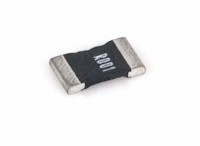
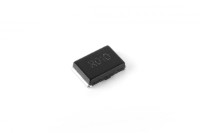
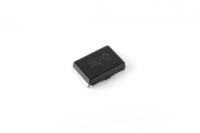
MFR Series Metal Foil Low-Resistance Chip Resistors
The MFR Series is a range of lead-free, halogen-free, RoHS-compliant metal foil low-resistance chip resistors built on an alumina ceramic substrate, designed for high-precision current sensing and voltage division across a wide resistance range in surface-mount assemblies. Power ratings span 0.5W to 5W across twelve case sizes — MFR0603, MFR0805, MFR1206, MFR2010, MFR2512, MFR3921, MFR4527, MFR0508, MFR0612, MFR0815, MFR1225, and MFR2139 — and resistance values extend from 1mΩ to 700mΩ depending on package. Tolerance options are ±0.5% and ±1.0%, and the operating temperature range is −55°C to +155°C.
A defining characteristic of the MFR Series is its dual-alloy element strategy. For resistance values up to approximately 9mΩ to 49mΩ (depending on case size), the resistive element uses manganese copper (MnCu) alloy, which delivers the lowest TCR, lowest thermoelectric EMF, and highest long-term stability. For higher resistance values within the same packages, a copper alloy (Cu Alloy) element is used, allowing the resistance range to extend to 100mΩ, 270mΩ, 500mΩ, 560mΩ, or 700mΩ depending on the case size, at a TCR of ±50ppm/°C to ±100ppm/°C. This material boundary is transparent to the user in terms of assembly and land pattern; the package dimensions and solder pad geometry are unchanged across the resistance range within each case size.
What are the MFR Series Metal Foil Low-Resistance Chip Resistors?
The MFR Series is a family of metal foil chip resistors that extends the foil technology platform to a broader resistance range and a wider selection of case sizes than is practical with MnCu alloy alone. The MFF Series, which uses MnCu throughout, is limited to a maximum of 100mΩ in its widest-range package. The MFR Series pushes this boundary to 700mΩ in the MFR1206, to 560mΩ in the MFR2512, and to 500mΩ in the MFR2010, by switching from MnCu to a copper alloy foil element at the resistance value where MnCu can no longer achieve the required resistance in a practical foil geometry. The result is a single product family covering the full range from 1mΩ to 700mΩ, with MnCu precision at the low-resistance end and copper alloy practicality at the high-resistance end, within consistent package outlines.
In the MnCu portion of the resistance range, the foil element is photolithographically patterned on the alumina substrate and bonded with epoxy adhesive, producing the same combination of very low inductance, low thermoelectric EMF, and tightly controlled TCR that characterises the MFF Series. The planar meander geometry of the foil minimises self-inductance, which is important in high-frequency sensing applications where inductive reactance would otherwise introduce phase error and waveform distortion in the sampled current signal. The low thermoelectric EMF between the MnCu element and the copper terminal electrodes is equally important in precision DC sensing circuits, where millivolt-level sense voltages must not be corrupted by thermally driven offset potentials at the element-terminal junction.
In the copper alloy portion of the resistance range, the foil construction and substrate architecture are identical, and the same low-inductance and long-term stability characteristics are retained. The TCR of the copper alloy element is specified at ±50ppm/°C across the range, which is competitive with metal alloy strip alternatives and superior to thick-film resistors at comparable resistance values. The thermoelectric EMF specification applies only to the MnCu variants and is not claimed for the copper alloy element, which is the primary technical distinction between the two material zones within the series.
Short-time overload is rated at 2.5 times rated power for five seconds for all types, with resistance change not exceeding ±1.0% plus 0.5mΩ — the same conservative overload rating as the MFF Series, reflecting the thin foil element geometry common to both. Environmental qualifications follow JIS C5201-1 and JIS C5202 methods, covering 1000-hour high-temperature storage at +155°C, 1000-hour low-temperature storage at −55°C, soldering heat resistance at 260°C, 100-cycle temperature cycling from −55°C to +155°C, 1000-hour moisture load life at 40°C and 90–95% RH, 1000-hour load life at rated current, mechanical shock at 100G for 11ms, and substrate bending with a 2mm deflection over a 90mm span. Marking uses two- to four-digit codes depending on case size, with ‘R’ denoting the decimal point in ohms and ‘M’ denoting the decimal point in milliohms.
MFR Series Metal Foil Low-Resistance Chip Resistors Specifications
A practical overview for engineers and procurement teams evaluating resistive solutions.
Model: MFR (Metal foil)
Resistor type: Metal foil
Description: Low resistance chip
Power Rating: 0.33W~5W
Resistance (Ω): 1m~700m
Tolerance (%): ±0.5, ±1
TCR (ppm/C): 50, 75, 100
Applications of the MFR Series Metal Foil Low-Resistance Chip Resistors
Where RARA current sensing resistors are deployed in the field.
High-precision current sensing in power supplies — output and input current measurement in switched-mode and linear power supplies across a wide range of output current ratings, where the MnCu foil element at low resistance values provides low TCR and low EMF, and the copper alloy element extends the same package to higher resistance values for lower-current sensing requirements.
Battery management systems — charge, discharge, and balancing current measurement in lithium-ion cells and modules where the extended resistance range of the MFR Series accommodates both high-current main pack sensing at low resistance values and auxiliary circuit sensing at higher resistance values within a consistent component family.
Measuring instruments and precision test equipment — reference shunt elements in current meters, power analysers, and precision source-measure units, where the MnCu foil variants in the lower resistance range deliver the low thermoelectric EMF and stable TCR required for traceable DC measurement accuracy.
Motor drive and inverter circuits — phase current sensing and DC bus monitoring in variable-speed drives and servo amplifiers, where the low inductance of the foil element at switching frequencies prevents measurement artefacts and the wide resistance range allows a single component family to serve both high-current inverter stages and lower-current auxiliary circuits.
High-frequency switching power conversion — current waveform sampling in high-frequency DC-DC converters and power factor correction stages, where the planar foil geometry minimises the inductive reactance that would otherwise introduce phase shift and distortion in peak or valley current mode control loops.
Entertainment electronics — current sensing in audio amplifier power stages, gaming console power management, and high-current consumer electronics supply circuits where stable sensing accuracy over the product service life is required.
Industrial control and automation — current feedback in process controllers, programmable logic controller power supplies, and field transmitters, where the MFR Series provides a stable, long-lived sensing element across the −55°C to +155°C operating range of demanding industrial environments.
Voltage division applications — precision resistive dividers and attenuators in instrumentation circuits requiring stable, predictable resistance ratios over temperature, taking advantage of the extended upper resistance range of the MFR Series, particularly the MFR1206 at up to 700mΩ and the MFR2512 at up to 560mΩ.
Related Products of the MFR Series Metal Foil Low-Resistance Chip Resistors
Model: LR
Resistor type: Metal alloy
Description: Low resistance
Power Rating: 0.5W~5W
Resistance (Ω): 0.2m~300m
Tolerance (%): ±0.5, ±1, ±2, ±5
TCR (ppm/C): 25-175

Model: LR2512H
Resistor type: Metal alloy
Description: Low resistance
Power Rating: 2W~3W
Rated Current: 17.3A
Resistance (Ω): 10m~80m
Tolerance (%): ±1, ±2, ±5
TCR (ppm/C): 50
Model: LRE
Resistor type: Metal alloy
Description: Low resistance
Power Rating: 1/6W~1W
Resistance (Ω): 0.2m~300m
Tolerance (%): ±0.5, ±1, ±2, ±5
TCR (ppm/C): 1-175
Model: MR
Resistor type: Metal alloy
Description: Low resistance
Power Rating: 2W, 3W, 5W
Resistance (Ω): 4m~100m
Tolerance (%): ±1, ±2, ±5
TCR (ppm/C): 50, 75, 200
Why Choose RARA Current Sensing Resistors
What sets RARA apart for engineers and procurement managers in industrial and automotive markets.
01
8 Sub-Categories
No other single supplier covers AEC-Q200 chip shunts, milliohm precision types, four-terminal Kelvin shunts, power metering, and 12,000A panel shunts under one ISO-certified roof.
02
Extreme Precision
HPS, UHPS, and PSS precision shunts deliver ±0.05% tolerance and 3 ppm/°C TCR — meeting the accuracy demands of EV battery coulomb counting, precision power analyzers, and billing-grade energy metering.
03
Automotive Qualified
Multiple AEC-Q200 certified models (BCS, LRA, ECS, BWR, TCS, PCBS) with IATF 16949 manufacturing certification — covering EV battery management, motor control, and charging applications.
04
Global Track Record
Trusted by Tesla, GM Korea, Proterra, Siemens, Rockwell, and Schneider Electric — deployed in EV powertrains, industrial drives, and utility metering systems across six continents.