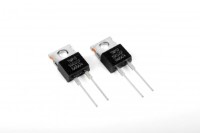
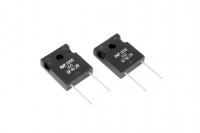
The TNP10, TNP20S, and TNP50U are heatsinkable power thin film resistors in industry-standard transistor packages, designed to deliver precision resistance performance at power levels requiring direct thermal coupling to a heatsink. The TNP10 uses a TO-220 package and is rated for 20W when properly heatsunk, the TNP20S occupies the same TO-220 footprint at 35W, and the TNP50U steps up to a TO-247 package to achieve 50W continuous dissipation. In each case, the mounting tab attaches directly to the heatsink surface — the use of thermal compound is recommended to minimise interface thermal resistance and achieve the full rated power output. The familiar transistor package format means the TNP series integrates directly into PCB layouts and heatsink assemblies already designed for TO-220 and TO-247 semiconductor devices, simplifying both mechanical and thermal design.
The resistance range of 0.02Ω to 510kΩ is exceptionally broad for a heatsinkable power resistor series, spanning from milliohm-level current sensing and low-impedance damping applications through to high-impedance voltage division and bias networks. Tolerance options of ±1% and ±5% allow the series to be specified for precision circuit roles — such as feedback networks, reference loads, and instrumentation circuits — as well as standard power dissipation duties. Three TCR grades of 50ppm/°C, 100ppm/°C, and 250ppm/°C provide a choice between tighter temperature stability for accuracy-sensitive designs and the more economical standard TCR grade for general-purpose use.
The thin film construction differentiates the TNP series from thick film alternatives in the same package format. Thin film resistors are produced by vacuum-sputtering a metallic alloy layer — typically a nickel-chromium compound — onto a ceramic substrate, then laser-trimming to achieve the target resistance value. This process produces a resistive element with lower noise, tighter initial tolerance, better TCR linearity, and superior long-term stability compared to thick film. The non-inductive design is inherent to the planar thin film geometry, avoiding the helical pattern that introduces inductance in metal film resistors, and results in very low series inductance that is essential in gate drive, snubber, and RF-adjacent circuit applications where inductive parasitics would degrade performance. The combination of high precision, low noise, and non-inductive construction makes the TNP series suitable for applications in power electronics, precision measurement, and audio where a heatsinkable resistor with true thin film characteristics is required.
Application note: In power electronics, the TNP series is applied as gate resistors for IGBT and MOSFET switching devices — where the TO-220 or TO-247 package co-locates the resistor with the switching device on the same heatsink, simplifying layout and thermal management. As snubber resistors across switching nodes and freewheeling diodes, the non-inductive thin film element damps voltage transients without introducing resonance. In precision power supply and current source circuits, the ±1% tolerance and low TCR variants provide the accuracy required for current sensing, constant-current regulation, and feedback load resistors. For audio and measurement applications, the low noise characteristic of thin film resistors is a significant advantage over wirewound or thick film alternatives, and the heatsinkable package extends the usable power level well beyond what a conventional axial or surface-mount precision resistor can handle. The wide resistance range further enables the TNP series to serve as a single qualified resistor family across a broad spectrum of circuit functions within a given product design.