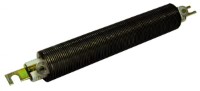
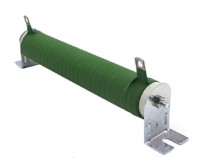
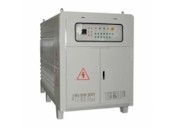
EWS Series Edge Wound Resistors
Resistance wire wound on edge around a ceramic core for maximum surface area and heat dissipation
Power rating from 400W to 1600W
Resistance range 0.02Ω to 1Ω
Tolerance options ±5% and ±10%
TCR ±800ppm/°C maximum
Designed for high-energy braking, motor control, and continuous heavy-duty industrial service
STEP files available for mechanical integration
What are the EWS Series Edge Wound Resistors?
The EWS Series is a range of high-power edge wound resistors designed for demanding industrial applications where large amounts of energy must be dissipated reliably and continuously. Unlike conventional axial wire wound resistors where resistance wire is wound flat against a core, edge wound construction orients the resistive ribbon on its edge as it spirals around the ceramic former. This geometry substantially increases the exposed surface area of the resistive element compared to the core footprint, allowing significantly more heat to be transferred to the surrounding air per unit of physical length. The result is a resistor capable of handling 400W to 1600W of continuous power dissipation in a form factor that remains practical for panel and enclosure mounting.
The resistance range of the EWS Series spans 0.02Ω to 1Ω, reflecting the series’ primary role in braking and motor control circuits where very low impedance loads are required to absorb high currents at relatively low voltages. The low resistance values combined with high power ratings give the EWS Series the ability to handle the large instantaneous currents that arise when a variable frequency drive decelerates a heavy motor load, or when a servo system performs rapid repetitive positioning cycles. Tolerance options of ±5% and ±10% are available across the range, with a temperature coefficient of resistance (TCR) of ±800ppm/°C maximum — appropriate for power dissipation service where precise absolute resistance is less critical than thermal stability and mechanical robustness.
The ceramic former provides both electrical insulation and dimensional stability at the elevated operating temperatures characteristic of sustained high-power duty. The open construction of the edge wound element allows natural convection to remove heat from the resistor body without requiring direct contact with a heatsink, simplifying mechanical installation compared to heatsinkable flat-pack types. This makes the EWS Series straightforward to mount in ventilated control cabinets and drive enclosures, with the element geometry itself acting as the primary thermal management structure.
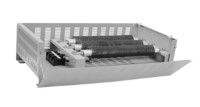
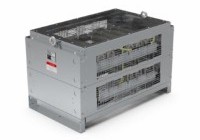
The EWS Series sits at the single-unit end of RARA’s edge wound product family. For applications requiring higher total power dissipation beyond 1600W, RARA’s EW series provides pre-assembled edge wound resistor assemblies rated from 3kW up to 12kW, where multiple elements are combined into a single structural unit. The EWS and EW series together cover the full range of edge wound braking resistor requirements from individual drive axes up to large multi-motor industrial installations.
EWS Series Edge Wound Resistors Specifications
A practical overview for engineers and procurement teams evaluating resistive solutions.
Model: EWS
Resistor type: Wire wound
Description: Edge wound
Power Rating: 400W~1600W
Resistance (Ω): 0.02~1
Tolerance (%): ±5, ±10
TCR (ppm/C): 800 max.
Applications of the EWS Series Edge Wound Resistors
Where RARA wire wound resistors are deployed in the field.
Variable frequency drive (VFD) braking resistors — absorbing regenerative energy from motors during deceleration in conveyor, pump, fan, and compressor drives
Crane and hoist control systems — dynamic braking resistors in overhead crane drives and hoisting equipment subject to repetitive heavy-duty braking cycles
Elevator and escalator drive systems — braking and load resistors in traction elevator controllers where rapid, repetitive energy dissipation is required
Servo drive and motion control systems — low-resistance braking loads in high-cycle servo axes for machine tools, robotics, and automated manufacturing equipment
DC bus discharge networks — rapid discharge of high-voltage DC bus capacitors in drive systems during shutdown or emergency stop sequences
Industrial test equipment and load simulation — stable low-impedance load resistors for testing drive systems and power electronics under rated conditions
Marine and offshore drive systems — braking and load resistors in thruster drives, winch controllers, and deck machinery subject to continuous heavy-duty operation
Renewable energy inverters — dump load and crowbar resistors in wind turbine and solar power conditioning equipment requiring robust high-energy transient handling
Related Products of the EWS Series Edge Wound Resistors
Model: K
Resistor type: Wire wound
Description: Non-flammable
Power Rating: 15W-2000W
Resistance (Ω): 1~1200k
Tolerance (%): ±5, ±10
TCR (ppm/C): 200 max.

Model: EW
Resistor type: Wire wound
Description: Edge wound assembly
Power Rating: 3kW~12kW
Resistance (Ω): 0.05~48
Tolerance (%): ±5, ±10
TCR (ppm/C): 800 max.
Model: DBR
Resistor type: Wire wound
Description: Dynamic braking
Power Rating: 8kW~60kW
Resistance (Ω): 1~150
Tolerance (%): ±5, ±10
TCR (ppm/C): 800 max.
Model: RLB
Resistor type: Wire wound
Description: Load bank
Power Rating: 50kW~3000kW
Resistance (Ω): 0.1~1M
Tolerance (%): ±5, ±10
TCR (ppm/C): 200
Why Choose RARA Wire Wound Resistors
What sets RARA apart for engineers and procurement managers in industrial and automotive markets.
01
Widest Design Range
From 0.5W precision types to 12kW edge wound assemblies — one wire wound product family covering precision, ceramic-encased, fusible, non-flammable, and high-power variants.
02
Precision Available
The PWR series delivers ±0.1% tolerance and TCR as low as 20 ppm/°C — precision wire wound performance for instrumentation and measurement circuits.
03
Automotive Qualified
The AQL ceramic-encased series is AEC-Q200 qualified for automotive-grade reliability in EV battery management, HVAC, and powertrain applications.
04
Global Track Record
Trusted by Siemens, Rockwell, Toshiba, Schneider Electric, LG, and Hanwha — a customer base built on decades of consistent, certified performance.