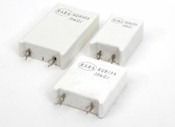
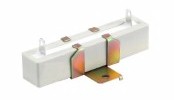
RQB Series Ceramic Encased Wire Wound Resistors
Core options — Glass fibre core (GC), ceramic core (CC), and metal oxide film (MO)
Power ratings — 5W, 7W, 10W, 15W, and 20W
Resistance range — 0.1Ω to 100kΩ depending on core type and wattage (E-series values)
Tolerance — ±5% for resistance values above 1Ω; ±10% for values at or below 1Ω
Temperature coefficient of resistance — ±260ppm/°C for GC and CC cores; ±400ppm/°C for MO variants
Operating temperature range — −25°C to +155°C
Dielectric withstanding voltage — AC 1500V for 1 minute
Insulation resistance — 20MΩ minimum at DC 500V
Short time overload — 10 times rated power for 5 seconds
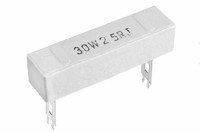
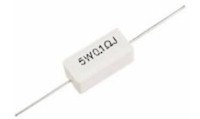
Terminal styles — Standard axial leads (S), short-lead (S3), and radial/dual inline (D)
What are the RQB Series Ceramic Encased Wire Wound Resistors?
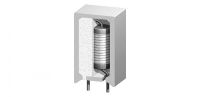
The RQB is a range of ceramic encased wire wound resistors designed for general-purpose power dissipation in industrial and commercial electronic equipment. The ceramic enclosure serves a dual function: it provides mechanical protection for the wire wound resistive element and acts as an electrical insulator capable of withstanding AC 1500V for one minute, making the series suitable for line-voltage environments where creepage and clearance requirements must be met.
Three core constructions are offered, each optimised for a different segment of the resistance range. The glass fibre core (GC) variant covers lower resistance values starting from 0.1Ω, providing a stable base for high-current applications. The ceramic core (CC) variant extends the range further, while the metal oxide film (MO) construction addresses higher resistances up to 100kΩ, though with a wider temperature coefficient of ±400ppm/°C compared to the ±260ppm/°C of the wound core variants. Across all constructions, tolerance is ±5% for values above 1Ω and ±10% for values at or below 1Ω.
Five power ratings are available — 5W, 7W, 10W, 15W, and 20W — each corresponding to a distinct body length that increases progressively to maintain surface temperature within safe limits. The operating temperature range of −25°C to +155°C covers the majority of industrial ambient conditions without derating. Long-term reliability is confirmed by a 500-hour load life test and a separate 500-hour moisture resistance test, with resistance drift limits specified for both. A short-time overload rating of ten times rated power for five seconds confirms robustness against transient surges that are common in switched and motor-drive circuits.
The RQB is offered in three lead configurations. The standard S style provides long axial leads suitable for through-hole PCB assembly or panel wiring. The S3 style provides shorter leads for more compact layouts. The D style uses a dual inline or radial format for upright mounting. This variety of termination and body sizes allows the RQB to be specified across a wide range of PCB, chassis, and cabinet-mounting applications without the need for a different product family.
RQB Series Ceramic Encased Wire Wound Resistors Specifications
A practical overview for engineers and procurement teams evaluating resistive solutions.
Model: RQB
Resistor type: Wire wound
Description: Ceramic encased
Power Rating: 5W~20W
Resistance (Ω): 0.1~100k
Tolerance (%): ±5, ±10
TCR (ppm/C): 260, 400
Applications of the RQB Series Ceramic Encased Wire Wound Resistors
Where RARA wire wound resistors are deployed in the field.
The RQB series is suited to a broad range of industrial and commercial power electronics applications where ceramic encased through-hole resistors are required for reliable, cost-effective power dissipation. Typical uses include load resistors and discharge networks in power supplies and UPS systems, current-limiting and inrush-current protection resistors in AC and DC drive circuits.
Snubber and damping resistors in motor control and inverter assemblies, bleeder and voltage-divider resistors in high-voltage measurement and power conditioning equipment, braking and dynamic discharge resistors in variable speed drive systems, and protective series resistors in relay driver, solenoid, and actuator circuits.
The ceramic body and robust wire wound construction also make the RQB suitable as a protective element in surge-prone environments such as industrial automation panels, heating control systems, and test and measurement load banks where long-term stability under repetitive thermal cycling is required.
Related Products of the RQB Series Ceramic Encased Wire Wound Resistors
Model: RQA
Resistor type: Wire wound
Description: Ceramic encased
Power Rating: 5W~20W
Resistance (Ω): 0.1~100k
Tolerance (%): ±5, ±10
TCR (ppm/C): 260, 400
Model: RQR
RResistor type: Wire wound
Description: Ceramic encased
Power Rating: 2W~12W
Resistance (Ω): 0.1~75k
Tolerance (%): ±5, ±10
TCR (ppm/C): 260, 400
Model: RQR15~40
Resistor type: Wire wound
Description: Ceramic encased
Power Rating: 15W~40W
Resistance (Ω): 0.01~54k
Tolerance (%): ±0.5, ±1, ±2, ±5, ±10
TCR (ppm/C): 260 (max.)
Model: RQL
Resistor type: Wire wound
Description: Ceramic encased
Power Rating: 10W~40W
Resistance (Ω): 0.3~100k
Tolerance (%): ±5, ±10
TCR (ppm/C): 260, 400
Why Choose RARA Wire Wound Resistors
What sets RARA apart for engineers and procurement managers in industrial and automotive markets.
01
Widest Design Range
From 0.5W precision types to 12kW edge wound assemblies — one wire wound product family covering precision, ceramic-encased, fusible, non-flammable, and high-power variants.
02
Precision Available
The PWR series delivers ±0.1% tolerance and TCR as low as 20 ppm/°C — precision wire wound performance for instrumentation and measurement circuits.
03
Automotive Qualified
The AQL ceramic-encased series is AEC-Q200 qualified for automotive-grade reliability in EV battery management, HVAC, and powertrain applications.
04
Global Track Record
Trusted by Siemens, Rockwell, Toshiba, Schneider Electric, LG, and Hanwha — a customer base built on decades of consistent, certified performance.