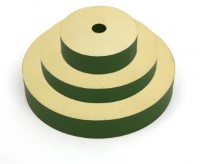
83-D Series Bulk Ceramic & Organic Resistor Discs
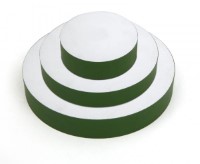
Bulk ceramic and organic resistive element in solid flat disc form factor
Power rating 18W to 180W depending on disc diameter and thickness
Resistance range 2mΩ to 235MΩ — the widest resistance range in the 83-series family
Tolerance options ±5%, ±10%, and ±20%
Negative TCR −500 to −1500 ppm/°C — resistance decreases as temperature rises
Inherently non-inductive construction — energy dissipated uniformly through the entire ceramic body
Contact surfaces available in aluminium or brass metallisation
Anti-track coating available on the outer diameter between the contact surfaces
What are the 83-D Series Bulk Ceramic & Organic Resistor Discs?
The 83-D is a bulk ceramic and organic composition resistor in solid flat disc form, manufactured by sintering resistive particles within a binding medium to produce a dense, homogeneous cylinder of low aspect ratio. Where the 83-W washer uses a central bore to allow through-bolt mounting, the 83-D disc is a fully solid component whose flat face geometry provides the maximum possible resistive cross-section for a given outer diameter, and whose large flat contact surfaces facilitate reliable metallised connections over a wide area. This geometry gives the 83-D a particularly broad resistance range — from 2mΩ at the lowest end to 235MΩ at the highest — which is the widest span in the entire 83-series family and makes it the only variant capable of covering both ultra-low-resistance current-sensing and ultra-high-resistance bleeder and voltage-divider roles within a single product line.
Like all members of the 83-series, the 83-D is manufactured from sintered bulk ceramic material and therefore exhibits a negative temperature coefficient of resistance (TCR) of −500 to −1500 ppm/°C. As current flows and the disc body warms, its resistance falls, allowing the circuit to transition from a high-impedance cold state to a lower-impedance warm operating condition without any active switching. In surge and inrush scenarios this self-regulating behaviour is inherently protective: the disc presents high resistance at the onset of a transient event, limiting the peak current, and then naturally reduces its resistance as the ceramic mass absorbs energy and heats up. The absence of any wound wire or deposited film means that the 83-D is inherently non-inductive and dissipates energy uniformly throughout its full cross-section and thickness, avoiding the localised surface heating that limits the surge tolerance of film and wirewound alternatives.
Power ratings span 18W to 180W across the available disc sizes, and the anti-track coating option available on the outer diameter surface between the contact metallisation bands extends the component’s operating voltage headroom by suppressing surface discharge tracking in high-voltage service environments. Contact surfaces are metallised in either aluminium or brass to ensure consistent, low-contact-resistance connections to terminal hardware, clamping assemblies, and bus bar fixtures. Multiple discs can be assembled in stacked or parallel configurations to achieve power ratings or resistance values beyond those of a single component. Part numbers encode the material type, the disc size designation, the thickness code, the resistance value in the standard three-digit format (two significant figures followed by a multiplier, or the letter R in place of the multiplier for values below 10Ω), and a tolerance suffix of J for ±5%, K for ±10%, or L for ±20%.
83-D Series Bulk Ceramic & Organic Resistor Discs Specifications
A practical overview for engineers and procurement teams evaluating resistive solutions.
Model: 83-D
Resistor type: Bulk Ceramic
Description: Organic disks
Power Rating: 18W~180W
Resistance (Ω): 2m~235M
Tolerance (%): ±5, ±10, ±20
TCR (ppm/C): -500~-1500
Applications of the 83-D Series Bulk Ceramic & Organic Resistor Discs
Where RARA ceramic resistors are deployed in the field.
Bleeder and discharge resistors in high-voltage power supplies — resistance values up to 235MΩ allow the 83-D to serve as a high-impedance bleed path that safely discharges filter capacitors after power removal without drawing significant continuous current
Capacitor bank charge and discharge circuits — bulk ceramic construction tolerates repetitive high-energy charge-discharge cycles; non-inductive disc geometry avoids the inductive transients that wirewound types introduce into fast-discharge circuits
Defibrillator charge management and medical high-voltage equipment — the combination of very high resistance values and surge-tolerant bulk construction satisfies the requirements of implantable and external defibrillator energy storage and discharge circuits
Crowbar and overvoltage protection networks — fast volumetric energy absorption across the full disc cross-section withstands abrupt fault-level transients without surface film failure or wire rupture
Impulse voltage generators and high-voltage pulse duty circuits — non-inductive solid disc elements absorb and dissipate high-energy pulses without introducing inductive overshoot or ringing
Voltage divider networks in high-voltage measurement and instrumentation — the upper resistance range extending to 235MΩ enables precision high-voltage division with minimal loading of the circuit under test
AC and DC motor drives and dynamic braking systems — disc resistors handle the surge energy returned from the motor during deceleration and limit inrush current at startup
Electrical transmission and distribution equipment — compact disc format integrates into switchgear, bus bar assemblies, and substation protection circuits for fault current limiting and surge absorption
Temperature compensation networks — the negative TCR characteristic can be paired with positive-TCR components in bridge circuits and process control instrumentation to produce networks with controlled or stable overall resistance across a temperature range
Industrial test and measurement equipment — stable, non-inductive high-power reference loads and precision high-resistance standards for calibration, high-voltage acceptance testing, and insulation resistance verification
Related Products of the 83-D Series Bulk Ceramic & Organic Resistor Discs
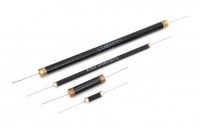
Model: 83-A
Resistor type: Bulk Ceramic
Description: Axial lead rods
Power Rating: 2.2W~7W
Resistance (Ω): 6~977k
Tolerance (%): ±5, ±10, ±20
TCR (ppm/C): -500~-1500
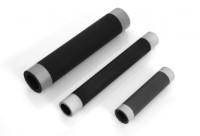
Model: 83-T
Resistor type: Bulk Ceramic
Description: Tubes
Power Rating: 12W~352W
Resistance (Ω): 1~295k
Tolerance (%): ±5, ±10, ±20
TCR (ppm/C): -500~-1500
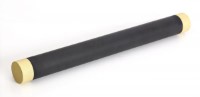
Model: 83-R
Resistor type: Bulk Ceramic
Description: Rods
Power Rating: 4.7W~445W
Resistance (Ω): 0.9~244k
Tolerance (%): ±5, ±10, ±20
TCR (ppm/C): -500~-1500
Model: 83-W
Resistor type: Bulk Ceramic
Description: Organic, washers
Power Rating: 3.8W~327W
Resistance (Ω): 20m~6.8k
Tolerance (%): ±5, ±10, ±20
TCR (ppm/C): -500~-1500
Why Choose RARA Ceramic Resistors
What sets RARA apart for engineers and procurement managers in industrial and automotive markets.
01
Unique Negative TCR
The -500 to -1500 ppm/°C negative TCR is a fundamental property of sintered bulk ceramic — exploited in inrush limiting, soft-start, and temperature compensation circuits where resistance must decrease with temperature rise.
02
Surge Tolerant by Design
The bulk distributed construction absorbs pulse and surge energy throughout the entire volume of the component — giving ceramic resistors exceptional pulse handling capability compared to surface-film types of equivalent power rating.
03
Five Form Factors
Axial rods, bare tubes, bare rods, washers, and disks — five geometries covering through-hole PCB, chassis, in-line bus bar, and panel mounting requirements in a single product family.
04
Global Track Record
Trusted by Siemens, Rockwell, Schneider Electric, and Hanwha — deployed in industrial power electronics, inrush protection, and surge limiting applications across six continents.