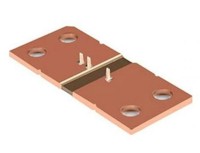
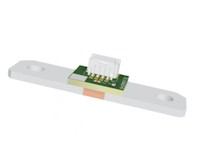
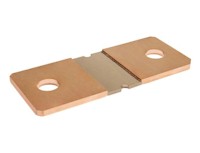
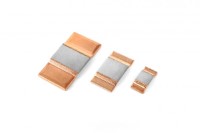
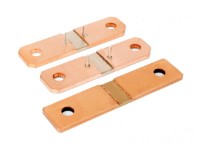
The TCSN5216, TCSN6016, TCSN6918 and TCSN8518 are four-terminal, bus-bar, metal strip current shunts built using electron beam welding, sharing the same low-inductance, high-stability construction as the rest of the TCSN series. The model numbers reflect the increasing physical length of the bus-bar element, from 52mm for the TCSN5216 up to 85mm for the TCSN8518, with the larger parts offering higher power ratings, higher continuous current capability, and a wider choice of resistance values to suit different sensing-voltage and accuracy requirements. The TCSN5216 and TCSN6016 are fixed at a single 0.1mΩ resistance value, while the TCSN6918 and TCSN8518 extend the offering to four values — 0.05mΩ, 0.1mΩ, 0.125mΩ and 0.25mΩ — allowing the sensed voltage to be tailored to the downstream amplifier or measurement circuit.
As with other members of the TCSN family, these parts are designed to absorb high pulse power while maintaining very low inductance and excellent frequency characteristics, making them suitable for sensing fast-changing or pulsed currents without the signal distortion that inductance would otherwise introduce. Voltage sensing is available in several configurations across all four models: a standard non-tap version, a press-fit type using nickel-tin plated pins, and a tap (or hole) type using an M3 tap or hole. An optional nickel-tin terminal plating is also available. The TCSN6918 and TCSN8518 carry a printed marking and QR code for full traceability, recording model, size, tolerance, production date, serial number, supplier, lot number, batch number and resistance value in nano-ohms; the smaller TCSN5216 and TCSN6016 carry the marking information only, without a QR code, as their bus-bar area is too small to print one legibly.
Power ratings across the series follow a derating curve referenced to terminal temperature: full rated power is available up to roughly 140°C, after which allowable power falls approximately linearly to zero as the terminal approaches the 170°C upper operating limit. All four models are qualified against the same demanding set of environmental and mechanical tests, including TCR verification from −40°C to +140°C, 260°C solder heat resistance, 1000-hour load life cycling at rated current, high-temperature and high-humidity exposure, 1000-cycle temperature cycling between −55°C and +155°C, 1000-hour high-temperature storage at 170°C, low-temperature load testing down to −45°C, vibration testing across 10 to 2000Hz at 5g over three axes, and mechanical shock testing at 100g with a 6ms half-sine pulse in six directions. Extended resistance values beyond those listed are available on request.