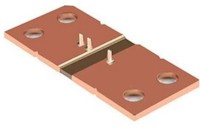
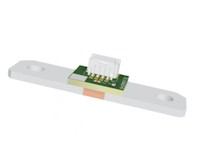
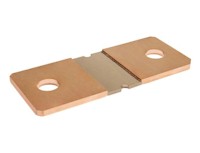
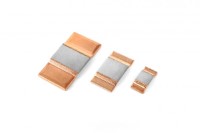
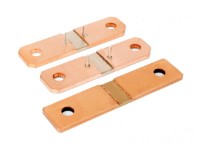
The TCSN8536 is part of RARA's TCSN series of bus-bar current shunts, built as a four-terminal metal strip element joined to copper terminals by electron beam welding, giving an all-metal, solder-free current path. Beyond the long-term stability and low TCR shared with other shunt families, the TCSN series is specifically engineered to absorb high pulse power and to maintain very low inductance, below 5nH, together with excellent frequency characteristics. This combination of high pulse-handling capability and low inductance makes the TCSN8536 well suited to fast-changing or pulsed current waveforms where a standard shunt's inductive reactance would distort the measured signal.
Voltage sensing on the TCSN8536 can be configured in several ways to suit different assembly methods: a standard non-tap version for direct PCB mounting, a press-fit type with nickel-tin plated press-fit pins, and a tap (or hole) type using an M3 tap or hole for screw-terminal sensing connections. Terminal plating is also available as an option, with a nickel-tin finish offered alongside the standard unplated terminal. Each part carries a printed marking and QR code identifying the model, size, tolerance, production date, serial number, supplier, lot number, batch number and resistance value in nano-ohms, supporting full traceability through manufacturing and field use.
As with the part's power rating, the 50W maximum applies up to a terminal temperature of approximately 140°C, after which the derating curve reduces allowable power roughly linearly to zero as the terminal approaches the 170°C upper limit, reflecting the bus-bar's conduction-dominated thermal path. The TCSN8536 is qualified against an extensive set of environmental and mechanical tests, including TCR verification from −40°C to +140°C, 260°C solder heat resistance, 1000-hour load life cycling at rated current, high-temperature and high-humidity exposure, 1000-cycle temperature cycling between −55°C and +155°C, 1000-hour high-temperature storage at 170°C, low-temperature load testing down to −45°C, vibration testing across 10 to 2000Hz at 5g over three axes, and mechanical shock testing at 100g with a 6ms half-sine pulse in six directions. Extended resistance values beyond the three listed are available on request.